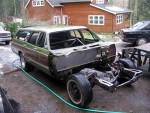
While this may appear to be some sort of photographic trickery, the bumper car shown here is actually moving under its own power. The man behind the wheel restored this genuine midway-style bumper car, and installed a small gasoline engine in place of the original electric motor. Paul claims a blistering top speed of 25 miles per hour. If the cadre of super scientists could figure out a working wireless electrical power transmission network, one could re-install a more powerful electric motor and hit the accelerator down the Nikola Tesla high velocity electric motorway.
Archive for March, 2009
Bumper Car Escapes Midway
So Neat They Are

When most folks hear “Saab Sonett,” their thoughts immediately turn to handsomely awkward fiberglass FWD coupes racing to 60 mph in 12.5 seconds flat thanks to a Ford sourced V4 engine. But that’s the mid-60s Sonett II. This friends, is the OG Swede racer aka the Sonett I. Desinged in a barn near Trollhättan by four guys named Rolf, Sven, Gotta and Olle (really), the Sonett was firt shown to the world in March of 1956 at the Stockholm Bilsalong (auto show). The plan called for 2,000 Sonetts in 1957. Sadly, the world at large wasn’t ready for a 1,300 pound Swedish roadster powered by a 57 hp two-stroke 748 cc three-banger, as only six Sonett I roadsters were ever built. But at least there were six. The Sonett’s name came from the Swedish, “Så nätt den är.” So neat they are, indeed. [photo Martin Bergstrand]
Suzuki Cervo Bonanza
From our Japan bureau comes this customized later seventies vintage Suzuki Cervo coupe. According to the materials at the mighty Clunkbucket research lab, this car featured a 3-cylinder 539 cubic centimeter air-cooled engine mounted transversely out back that spun the rear wheels with nearly 40 horsepower! Exported versions of the coupe were rumored to have been sent out equipped with a water cooled four-banger. This stylish Cervo comes from some car show mania that we sadly missed. For more examples of what happens when American hot rod and kustom mayhem intersects with Japanese car culture head on over to the home of Crown Classics.
Far Better at Snacking
Even though we certainly list snacking as an activity around here at the Clunkbuckets, it is time for us to make a clarifying announcement. There are those on the internets with a similar name that are far more proficient at snacking than us. Cluckbucket with a C bills themselves as the greatest chicken wing site in the world. We believe them. Behold the story of Scott “Cluckbucket” Roth. While we will do our best to combine our love of cars and snacking together in future content, there is slim chance of us ever attaining the level of snacking greatness as the guys with the wings and the SnacDaddy full of deliciously greasy and salty goodness. Clunkbucket with an N are us. Cluckbucket with a C are them. Learn the difference. Love the difference. Celebrate snacking.
Origins of Jam Car
While driving on the freeways of the bay area you may often hear me exclaim, “jam car” in reference to singular or multiple Prius hybrids jamming up the lanes. This would not be the first time for phrases shouted in cars. Because people often look at me like I have lobsters coming out my eyes when I say jam car, an explanation. Jam car refers to the original jam car, shown here. This third car came as part of the Total Control Racing sets made by the IDEAL toy company. Unlike conventional slot cars, the TCR race cars could be steered from lane to lane via a button on the controller. The jam car, much like Prius hybrids, moved around the track slowly, and would change lanes at random. Jam car shown available here.
Find a Shop Manual
We often field queries concerning a repair or upgrade to a particular part and vehicle. How do I replace the heater core on my 1973 Ford Pinto wagon, or swap out a dead alternator on my 1982 Toyota Cressida? There are really two answers to these questions. The first is we don’t know, exactly. The second is about the same way you would on any other car. The specific answers to these and countless related questions lie in the vehicle service and repair manual.
While there are certainly a large part of the wrench spinning public who would throw directions to the wind, guidance can be a good thing when it comes to parts not flying off the car, arriving in one piece is victory! Finding the service manual can be half the battle. Read on for a few tips in locating the books for everything from a 1979 Plymouth Fire Arrow to a to a 1987 Mitsubishi Starion.
LeMon of the Week
Do you know what the biggest problem with the 24 Hours of LeMons is? Exactly, not enough French cars! Well friends, for the low, low price of just $700, you can help change that. And this particular Renault has so much going for it. First off, it’s in Benzonia! Located in Ted Nugent country (Northern Michigan), this car is shockingly free from both bullet holes and moose vomit. Rare indeed. Not that I know anything about French wine, but assuming 1976 was a good vintage, I’m sure the same holds true for French cars. That’s right, this baby could be a winner! Could be? Hell, the nickels are practically in your pocket. While it’s true you can’t spend more than $500 on your finished LeMons car, nothing is stopping you from selling parts to get you below the limit. And look – it’s still got the canvas sliding top! You just know there’s a degenerate connoisseur in a Renault club somewhere that understands the true value of a vintage part like that. The seller does admit that this particular Le Car has sat in a barn for 18 years and the engine is, “a big question mark.” Oh, it has a bad (i.e. rusted to death) rear floor, too. But just think of all your future glory. Getting this dusty truffle running is definitely worth the stretch. Viva le Car! And thanks to Rory for the tip.
Disclaimer: A mild mannered motoring journalist by day, Jonny Lieberman dons the robe and econo-barrister wig as Judge Jonny on the 24 Hours of LeMons racing circuit. Together with Justice Murilee Martin they comprise the LeMons Supreme Court.
Go Gremlin Go!
We’re happy to report Wednesday night drag racing is alive and well in America. Proving that winning ugly can bring great reward is Dave Pekonen’s 1975 Levis edition AMC Gremlin X. The baby blue hatch runs in the low 11-second range at 120 miles per hour, and is driven at lessor speeds the 40 or so miles roundtrip to the track. Dave’s been running with the Gremlin for 20 years. The original 304 V8 mill was uprated to 401 cubic inches of Rambler power. When he’s not out at the drag strip in his AMC, you might also find Dave at Dave’s Auto Parts in Santa Rosa, California. For more information on Wednesday night drag racing action head on over to Infineon Raceway, or support your local drag strip!