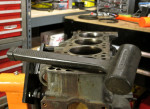
Direct from the Van Nuys desk of the Tool of the Week aptly named hammers division comes the dead blow hammer, or mallet. There are many hammer-mallets, but none have the unique functionality of the dead blow hammer. Inside the hollow plastic or steel center of the dead blow hammer head is a measure of sand or steel pellet shot. The pellets are similar to those found inside a shotgun shell. The shot dampens the rebound or bouncing associated with lesser hammers. The shot also softens the hammer blow to your wrist and hand. The quick-shifting shot even adds bonus power the hammer blow. The shot delivers its mass and inertia to the inside of the hammer face a split-second after contact with the frame rail, steel shelving, 55-gallon drum lid, or whatever else is being hammered. Bonus double hit!
While the dead blow hammer is great for smacking together wooden joists, convincing automotive chassis parts into place, or use anyplace where a focused blunt force is required, the somewhat malleable faces of the hammer are not suited for use on sharp objects such as chisels or nails. Some dead blow hammers and kits come with replaceable faces, making these dead blow hammers akin to the subject kid in one of our favorite Richard Hell and the Voidoids songs – The Kid with the Replaceable Head. Always wear safety glasses when operating the dead blow hammer. A exceptionally mighty Thor-like hammer blow could cause the dead blow hammer head to asplode, sending plastic and steel shrapnel in every direction. Unless like the kid you can pick your replaceable heads at will from the shelf, wearing the safety glasses while hammering anything is a capital idea.
Special thanks to Alex Nunez for the Tool of the Week tip.
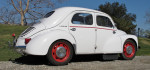
Over a million Renault 4CV sedans can’t be wrong. Sales of the 4CV hit half a million units in 1954, and surpassed the million mark by 1960. The 4CV was sold here in America, and manufactured under license as the HINO 4CV in Japan. And what’s not to like? Rear engine. Developed in total secrecy by a German-occupied WW2 France. Rear wheel drive. Cheap to buy when produced. Still relatively easy to hop-up with proven modifications, as long as there’s a few spare parts kicking around. Very light at 1230 or so pounds. The Volkswagen-like 4CV is even the progenitor of the rally-winning
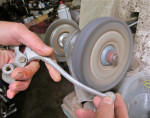
The pine-like Little Tree® was famous long before Miller handed one to Otto the ’80s classic movie Repo Man. You find one in every car. You’ll see. The shop or home garage is another place this object based continuum occurs. Be it on a bench or pedestal, most every garage or workshop in the land has at some point in its existence contained one (or more) bench grinder buffer-polisher machines. Some of these appeared recently, and still wear bright paint, a gooseneck light, and perhaps some manner of safety eye shield. Other bench grinder-polishers have achieved near invisibility in a corner of the garage, covered with a neutral gray mix of the dust from everything that ever touched its wheels over since Eisenhower was in the Oval Office. While most bench grinders are essentially an electric motor with a shaft on either end, others have more elaborate belt drive systems. The good machines will be passed on from one generation to the next, and serve in circular utility for many years to come. Lackluster or far-too-heavy to move units are often left behind in the garage or shop for the next person that wants to clean the threads on an rusty old bolt, or polish up some aluminum. The bench grinder is everywhere. You find one in every garage. You’ll see.
The American Heritage Dictionary defines jalopy as a word used to describe an old, dilapidated motor vehicle – especially an automobile. The origin of the word itself is hazy. The Ultimate Hot Rod Dictionary goes further, suggesting the word may have come into being as a result of many dilapidated automobiles sent to the Mexican city of Jalapa. The second definition of the word is the very automobile seen here. Any rough, oftentimes crudely constructed early-vintage automobile used in circle track operations during the ’40s and ’50s. Once driven by Benny Hofer, this is not just any jalopy, but a genuine 1940 two-door Ford coupe full race jalopy.
The motor homes across from the pits stretched out side-by-side a quarter-mile long and four rows deep, all the way back to the fence. On the deeper, wider pit side, there were hundreds of megabuck transporters and motor homes and trailers and a quadrillion dollars’ worth of vintage race cars, hot rods and customs. Orange groves, grape arbors and oil wells surround this hallowed, historic Kern County property, now littered with the entourages of 575 racing teams and those who came to urge them on. Nobody here was crying the blues. Everybody here was having fun. This was Famoso Raceway. This was The March Meet, 2010, and it was spectacular. Recession? What recession?