Saturday, February 4, 2012

CLUNKBUCKET

Everything but the same old cars

Archive for the ‘Tool of the Week’ Category

Tool of the Week: Dead Blow Hammer

Posted by Mike Bumbeck On March - 31 - 2010

dead-blow-hammerDirect from the Van Nuys desk of the Tool of the Week aptly named hammers division comes the dead blow hammer, or mallet. There are many hammer-mallets, but none have the unique functionality of the dead blow hammer. Inside the hollow plastic or steel center of the dead blow hammer head is a measure of sand or steel pellet shot. The pellets are similar to those found inside a shotgun shell. The shot dampens the rebound or bouncing associated with lesser hammers. The shot also softens the hammer blow to your wrist and hand. The quick-shifting shot even adds bonus power the hammer blow. The shot delivers its mass and inertia to the inside of the hammer face a split-second after contact with the frame rail, steel shelving, 55-gallon drum lid, or whatever else is being hammered. Bonus double hit!

While the dead blow hammer is great for smacking together wooden joists, convincing automotive chassis parts into place, or use anyplace where a focused blunt force is required, the somewhat malleable faces of the hammer are not suited for use on sharp objects such as chisels or nails. Some dead blow hammers and kits come with replaceable faces, making these dead blow hammers akin to the subject kid in one of our favorite Richard Hell and the Voidoids songs – The Kid with the Replaceable Head. Always wear safety glasses when operating the dead blow hammer. A exceptionally mighty Thor-like hammer blow could cause the dead blow hammer head to asplode, sending plastic and steel shrapnel in every direction. Unless like the kid you can pick your replaceable heads at will from the shelf, wearing the safety glasses while hammering anything is a capital idea.

Special thanks to Alex Nunez for the Tool of the Week tip.

Tool of the Week: Bench Grinder Buffer

Posted by Mike Bumbeck On March - 19 - 2010

bench-grinder-bufferThe pine-like Little Tree® was famous long before Miller handed one to Otto the ’80s classic movie Repo Man. You find one in every car. You’ll see. The shop or home garage is another place this object based continuum occurs. Be it on a bench or pedestal, most every garage or workshop in the land has at some point in its existence contained one (or more) bench grinder buffer-polisher machines. Some of these appeared recently, and still wear bright paint, a gooseneck light, and perhaps some manner of safety eye shield. Other bench grinder-polishers have achieved near invisibility in a corner of the garage, covered with a neutral gray mix of the dust from everything that ever touched its wheels over since Eisenhower was in the Oval Office. While most bench grinders are essentially an electric motor with a shaft on either end, others have more elaborate belt drive systems. The good machines will be passed on from one generation to the next, and serve in circular utility for many years to come. Lackluster or far-too-heavy to move units are often left behind in the garage or shop for the next person that wants to clean the threads on an rusty old bolt, or polish up some aluminum. The bench grinder is everywhere. You find one in every garage. You’ll see.

Tool of the Week: Snow and Ice Scraper

Posted by Mike Bumbeck On January - 29 - 2010

snow_scraperAs much of the world plunges into the sort of deep freeze that may be the work of a clandestine global super villian, the trusty snow and ice scraper seems the perfect mid-winter Ernst Starvo Blofeld edition of Tool of the Week. Growing up in New England meant carrying one or more of these handy tools around for nearly six months out of the year, along with a childhood chock-a-block with scraping and shoveling. The archetypal Clunkbucket was in fact a 1964 Volkswagen Beetle. The heat exchangers had corroded into nothing long before the car fell for 500 bucks into the hands of this freshly licensed driver, who was more or less as old as whatever German ferrous materials the Vermont road salt had not eaten away. The car came already equipped with a scraper. This bonus snow and ice scraper served well to remove frozen crud from the outside of the window in this heatless automobile. The three-inch wide miracle of plastic injection and space age polymer technology was also very handy for scraping ice from the inside of the front windshield. Especially while driving. Heating and defrosting systems have come a long way since the rusted 1964 Bug, virtually eliminating the need for in cabin ice scraping. Snow and ice scrapers have been improved to wider and brush-equipped telescoping handle versions as shown here. Odds are good that any used car glovebox in the Northeast will contain one or more seventies-style Plexiglas models, making the vintage tools not only useful but collectible.

Tool of the Week: Duct Tape

Posted by Mike Bumbeck On December - 4 - 2009

duct_tapeFrom the what can’t it fix division of Tool of the Week comes the ongoing miracle of duct tape. This sturdy and versatile tape is indispensable weapon in the Clunkbucket Arsenal of Tools, rivaling even bailing wire in its utility. The water repelling adhesive tape was originally made of cotton duck in green for the military. Duck tape was used to help keep ammo cases waterproof, and was also found effective for holding jeeps together. A post-war heating and ventilation construction boom had tape factories making lots of duck tape to hold metal duct work together. Green became silver. Duck became duct. Duct tape is now available in many colors.

Black duct tape has in fact held together the seven pieces of the original three-piece front air dam of the Starion for many years now. Not the same duct tape. Research has proven that a well placed strip of duct tape lined up with the painted black stripe on the lower part of the air dam is good for about three to six months of stock appearing durability. A roll of black duct tape now rides with the Starion at all times. Be advised. Going up on two wheels to get to the drive-in window before they run out of Shamrock Shakes may markedly decrease the effectiveness of duct tape on low-mounted front air dams.

Tool of the Week: Snap-Ring Pliers

Posted by Mike Bumbeck On September - 18 - 2009

snap_ring_pliersFrom the how did they get that thing in there division comes the snap-ring pliers edition of Tool of the Week. Snap-rings themselves are also known as circlips, rotor rings, and retaining rings. These flattish rings are usually found holding in a bearing or assembly by way of being stuck into a machined groove. In this case a pair of snap-rings was holding a piston onto a connecting rod by way of a steel pin. Snap rings can also be found holding u-joint bearing cups in place. Look closely before hammering.  A snap-ring pliers set or a fancy multipurpose pair of snap-ring pliers won’t get used too often, but you’ll be glad you have them when you run into a snap-ring. Attempting to remove a snap-ring or circlip with tools other than snap-ring pliers may have possibly lent these flat clips another name. The where did that damn spring steel thing go clip. In this case, a snap-ring assortment is a good plan.

Tool of the Week: Engine Stand

Posted by Mike Bumbeck On September - 2 - 2009

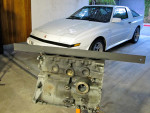
engine_transleadFrom the Mitsubishi forklift engine department comes this special Engine Stand bonus how-to edition of Tool of the Week. The Engine Stand is a purposeful tool that is designed to hold an engine block for dismantling and assembly. While these stands are great to have around, they do not posses an abundance of utility when not holding up an engine. Most engine stands are often seen in their natural habitat of back yards, or sides of houses half covered by a blue tarp. Up until recently, one of the Clunkbucket engine stands was holding up a spare Toyota 4K-C engine in the garage, and the other languishing in the back yard, holding up a blue tarp. The clarion call of free parts from the internets along with a drive to the wine country has since put the spare engine stand back into useful service holding up yet another Mitsubishi G54B turbo engine block. In the processes of this engine transport excursion we not only figured out that the Starlet can carry a spare engine, but that an engine stand can be used as a fulcrum to extract an engine block from the Starlet. We also put to the test the old maxim that free is always better than good. Read on for a step-by-step guide of something that by law we absolutely cannot recommend you attempt.

Step-by-Step Economy Engine Block Transport


Tool of the Week: Universal Joints

Posted by Mike Bumbeck On August - 24 - 2009

universal_socket_leadWelcome to the we’ll make it fit bonus trick edition of Tool of the Week. If there were an equal amount of space around every nut and bolt, we would all only need one kind of wrench. The reality is getting the twist to the fastener in just half the battle. What goes together like butter at the factory usually puts up a fight in the garage. Why did they put that bolt up there against the firewall? So folks would buy universal joint drives! Shown are impact and hand cranked varieties of universals, or wobblers, that have collected over time in the Clunkbucket Arsenal of Tools. The least expensive universals are the non-impact u-joint type, which have their own issue of wobbling around every direction except the one they should. Years ago we learned a trick to solve that problem with a short length of electrical tape. Follow a simple step-by-step for improved universal control.

Achieve Universal Control with this E-Z Tape Trick


Tool of the Week: Spark Plug Socket

Posted by Mike Bumbeck On August - 12 - 2009

spark_plug_socketWelcome to the dissimilar materials edition of Tool of the Week. Specialty sockets to remove oddly shaped oxygen sensors or inner ball joints are less common choices than the oft used spark plug socket. The genius of this specialty socket is the rubber donut that grabs onto the ceramic bit of the spark plug. The donut not only makes fishing the spark plug out of the hole an easy task, but also works in reverse to hold the spark plug in the socket when it comes time to thread the plug back in!

The rule is that the spark plug socket included as a bonus with any socket set will inevitably be the wrong size for the car or truck in the driveway. The extensive spark plug socket collection in the Clunkbucket Arsenal of Tools is the end result of having a few different cars. Modifications make things more fun. Anyone who has ever had a V8 equipped with a set of headers will attest to trying nearly every variety of spark plug socket and wobbler to find something that worked. Turbochargers can present similar problems. Spark plugs can also be fished out and threaded into the hole by pushing a length of leftover fuel and vapors line pushed over the insulator.

Tool of the Week: Fiat SST

Posted by Mike Bumbeck
Sep-3-2010 I 1 COMMENT

Replace Window Regulator

Posted by Mike Bumbeck
Aug-28-2010 I 1 COMMENT

Five Tips for DIY Automobile Repair

Posted by Mike Bumbeck
Jul-21-2010 I 8 COMMENTS