Can we get a loud amen, please, for the indoor car show? A couple of weekends ago, we got up very early on a Saturday morning, shot through the morning ritual, and headed our trusty ride from the suburbs down to the beating heart of Detroit to attend the 58th annual Detroit Autorama at Cobo Center, one of the oldest, largest and most widely respected indoor hot rod and custom car shows on the planet.
Auto show pioneer Bob Larivee and his right-hand man Bill Moeller have been doing this show and the other Autorama shows for a very long time now, and we are of the opinion that A nobody does it better and B, the Detroit show is among the very best of them, right up there with the Grand National Roadster Show, aka the Oakland Roadster Show, which is senior to the Detroit show by only three years (this year was the 61st). OK, the GNRS went from Oakland to San Francisco and is now more or less permanently located 400 miles south of Oakland in the L.A. suburb of Pomona. That’s OK, because the Detroit Autorama didn’t start out in Cobo Center in Detroit, either, because Cobo wasn’t finished until 1960. Its first home was the Coliseum at the Michigan State Fairgrounds on the north end of the city. Read the rest of this entry »
The motor homes across from the pits stretched out side-by-side a quarter-mile long and four rows deep, all the way back to the fence. On the deeper, wider pit side, there were hundreds of megabuck transporters and motor homes and trailers and a quadrillion dollars’ worth of vintage race cars, hot rods and customs. Orange groves, grape arbors and oil wells surround this hallowed, historic Kern County property, now littered with the entourages of 575 racing teams and those who came to urge them on. Nobody here was crying the blues. Everybody here was having fun. This was Famoso Raceway. This was The March Meet, 2010, and it was spectacular. Recession? What recession?
Walking on the hallowed patch ground that is Famoso Raceway it becomes easy to see why the March Meet is now in its 52nd year. People like this stuff. In our case a rekindled interest in drag racing and hot rodding started again around 15 years ago with a wiff of nitromethane and a flashback to the Coca-Cola Funny Car Cavalcade of Stars tossing up fiberglass down a seventies-soaked New England Dragway. Move the pointer to 2010, and the anachronism that is vintage drag racing is still largely intact. Freeze time around 1978, add a few thousand gallons of nitromethane, and never forget the associated junk and iconography. The first stop at every March Meet is always the swap meet at the top end of the race track. Exposure to all this goofball stuff started as a kid seeing a Funny Car supercharger bouncing on fire down the grass in front of the grandstands, liberated from its hemi thanks to the horrors of nitro. This of course led to launching the Mongoose and Snake Hot Wheels down what seemed like five miles of orange plastic track. And though we occasionally used to race down an actual drag strip with a ’67 Plymouth Barracuda later in life, it was all the stuff that came before moved moved us in that direction in the first place. The exquisite junk that is still with us all.
There were more Citroëns than drivers on a Saturday morning. The task at hand was a good one. Settle into the plush appointments behind the steering wheel of a 1969 and-one-half Citroën iD21F Safari Wagon and drive. The mission was to get all cars on the move to the Pasadena Art Center College of Design for a gathering of Citroëns, and subsequent tour of the Art Center automotive design facilities. After a few tries at a recalcitrant starter button and a couple minutes of warming up for the DS21 hemi-head engine, the wagon was up on its haunches and ready to swallow the road ahead. The wagon we were driving belongs to one Andy Takakjian, who would be piloting his other DS - a 1969 and-one-half iD 19 Series B Sedan in green that would lead the way on the first leg of the safari. Destination? Pasadena.
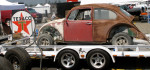
Proving wrong the previously held belief that a car is on a certain path to the jaws of the crusher once out on the California junkyard ground is this 1983 Toyota Corolla. We have lost count of how many near mint condition cars, trucks, and vans seen at the self-service junkyards of California that left us scratching heads as to why they were junked in the first place. This road burner was found in as shown here condition at a central California automobile recycling center. The latest owner of this Corolla saw the gem out in the yard and made a deal with the junkyard overlords. After some cash negotiations, the Toyota motored away from the boneyard under its own power! A brake and lamp inspection was required for the Corolla to earn a California salvage title. The rear wheel drive coupe passed California smog with 237 thousand miles on the stock 4AC engine, and made the trip to the December 2009 Santa Clara meet still wearing some yellow grease pencil from its previous date with the steel-gnashing jaws of death. One of the last of the rear wheel drive Corollas lives on. The stylish and practical luggage rack crossed over from the air-cooled rear engine scene by way of an old school Volkswagen Beetle. Old Toyotas never die, they just find older luggage racks.
The seventies were the absolute zenith of American station wagon manufacture. The flagships of the Ford station wagon fleet featured acres of simulated wood paneling – usually a shade lighter than the millions of sheets of actual dark brown wood paneling used to convert the basements of American split-level homes into rumpus or bar rooms. This fake wood paneling trend began with actual wood. 1950 was the first year of production for these most deluxe of Ford wagons, known as the Country Squire until the last monster lumbered off the assembly line in 1991. The 1951 version shown here at the 2009 Jimmy’s Old Car Picnic in San Francisco features genuine wood paneling. Owner Fernando Robleto picked up the Country Squire complete with wood and decided to leave the car in as found condition. A few replacement parts later along with a cooler full of beverages and the Squire was pressed back into intended service. “I was ready to start sanding it, and I thought – don’t touch it”, said Robleto of the well aged station wagon, made in part with the renewable resource known as wood.
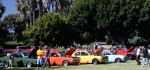
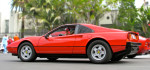
If you were traveling through L.A.’s San Fernando Valley on the first Sunday in November and experienced a sudden craving for a scoop of gelato, a double espresso, and a few puffs on a Gitanes, chances are you passed within spitting distance of the 2009 edition of the Best of France and Italy car show. With sunny skies above and a soundtrack which included French versions of Disney movie songs and the wail of fire engine sirens responding to a nearby brush fire purportedly sparked by a radio control aircraft mishap, hundreds upon hundreds of people jammed the lawn to gawk at row after gleaming (and not-so-gleaming) row of voitures and automobili, as well as cars that didn’t hail from France or Italy, but did have significant connections to one or both of the two nations. There were plenty of parts and automobilia dealers on hand, along with a dual citizenship’s worth of gastronomic delights. What could be more delightful than a car show with no less than five Facel Vegas?