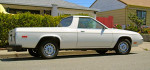
Even though almost a million units were produced over its nine year production run, the Volkswagen Brasilia is high on the list of cars one is unlikely to see rolling along the roads of North America. This 1975 Brasilia was driven up from Mexico by a man known to us only as Luis. The Brasilia was slammed after he got it back to the USA. TheĀ suspension was left stock for the journey north to handle the topes or any other on or off road obstacles along the way. Luis originally located the Brasilia in Mexico, and re-painted it there. Once the wagon-like VW was up north, Luis lowered it onto a set of eight-spoke EMPI Sprint Star wheels for the correct SoCal VW Cal-Look.
While it appears that perhaps the Brasilia is based on the VW Type III wagon and/or 412 wagon chassis, the car actually sits atop a VW Type I Bug chassis. The Brasilia is a Beetle under its own stylish steel skin. The Brasilia was designed and built by Volkswagen do Brasil, who were also responsible for creating the near-mythical Volkswagen SP1 and SP2 sports cars. The engine is an upright 1600cc with a shorter cooling shroud for the tight engine compartment fit. The Brasilia was a popular choice in the country whose capital city holds the same name. The wagon-like three door was manufactured from 1973 until 1982 for a total of 950,000 stylish, yet practical cars. It seems at least one extra hardy Brasilia has made it through to Mexico and then onto the USA. Luis drives his Brasilia a few days a week, or to whatever VW gathering he can make it to. Whichever comes first.
1975 Volkswagen Brasilia on EMPI Sprint Stars
In honor of Earth Day we present a car made largely of wood and glue. The 1967 Marcos GT is comprised of a sandwich of plywood and fiberglass that forms its gorgeous monocoque body. The resulting lightweight sports car is underpinned by conventional metal suspension bits, and what we can only assume is a powertrain that employs sophisticated metallurgy instead of Douglas Fir or Mahogany. This is not the first time the British have used wood in the construction of high-performance machines. The World War II de Havilland Mosquito twin-engine bomber was made by skilled craftsman using Ecuadorean balsa wood and Canadian birch along with a then new technological breakthrough called plywood, all bonded together with milk-derived Casein glues. This Timber Terror was so fast that it went out on bombing missions unarmed, as no enemy aircraft were fast enough to catch the Mosquito in the early part of the war.
Made largely of fiberglass. Engine in front with drive wheels out back. Not just one, but two flip-up fuel fill caps. Styling that hatches theories of Richard Teague getting a call from MI5 with a request to report to Norwich, UK in secret with the original plans for his
There are those who restore a car exactly as it came off the assembly line. Strategically placed paint inspection daubs and chalk marks are meticulously applied. The original style hose clamps, painted only with the correct value and hue of semi-gloss or flat black paint, are located precisely on correctly date-coded radiator and heater hoses. The body-color paint under the hood has drip runs and sags that directly correspond to the degree of hangover the original painter had that Monday in 1971 when he was spraying the lacquer into the engine bay. On the other side of this equation are the people that simply don’t care. These intrepid few are more interested in driving their classic car around. Case in point is this mystery Dart, which has parts from Mopar and AMC combined into one obviously still working machine. No, there was never a Dodge Charger Dart Sport Swinger with AMC slot mags ever produced. Except for this one. Seeing is believing. The caution tape was likely there to prevent the restoration crowd from getting too close and suffering an embolism. We don’t know who this mystery Dart belongs to, but we salute you.
A never ending search for a survivor first-gen Dodge D50-Plymouth Arrow Sport pickup truck combined with creative keywording of a local classified advertisements has unearthed another sort of captive import. Like the Dodge and Plymouth pickups, this 1974 Jeep is actually a Mitsubishi. Technically a Mitsubishi H-J58, the Mitsu-Jeep is a very near clone of its Willys cousin Jeep CJ3B. Mitsubishi manufactured all sorts of Jeeps under license from the Willys Jeep Corporation from 1953 to 1998. A 45-year run! Under the hood of this ’74 model is an early 2000 cc gasoline version of the mighty Astron series of Mitsubishi engines. The 4G52 cranks two or four wheels, and ran like a champ when we went to take a ride in the Mitsu-Jeep with current owner Steve Kopito over in Chatsworth, California. Steve is the proprietor of
Over a million Renault 4CV sedans can’t be wrong. Sales of the 4CV hit half a million units in 1954, and surpassed the million mark by 1960. The 4CV was sold here in America, and manufactured under license as the HINO 4CV in Japan. And what’s not to like? Rear engine. Developed in total secrecy by a German-occupied WW2 France. Rear wheel drive. Cheap to buy when produced. Still relatively easy to hop-up with proven modifications, as long as there’s a few spare parts kicking around. Very light at 1230 or so pounds. The Volkswagen-like 4CV is even the progenitor of the rally-winning
The American Heritage Dictionary defines jalopy as a word used to describe an old, dilapidated motor vehicle – especially an automobile. The origin of the word itself is hazy. The Ultimate Hot Rod Dictionary goes further, suggesting the word may have come into being as a result of many dilapidated automobiles sent to the Mexican city of Jalapa. The second definition of the word is the very automobile seen here. Any rough, oftentimes crudely constructed early-vintage automobile used in circle track operations during the ’40s and ’50s. Once driven by Benny Hofer, this is not just any jalopy, but a genuine 1940 two-door Ford coupe full race jalopy.
Crippling winter snow storms serve as a reminder that when the big snow or the Russians do show up, those all-season radials on that 1984 Plymouth Voyager in the driveway are not going to cut it. A snow shovel and some road salt might get the Voyager out of the driveway, but when you wake up to sub-zero weather and see Vladimir Putin doing shirtless chin ups on the kids swing set in your backyard, there had better be something heavy-duty out in the garage. The M-973 Cargo Carrier is equipped with not one but two sets of drive treads, a Mercedes five-cylinder turbodiesel, and can carry either 17 fully equipped troops or over two tons of supplies.