Monday, May 21, 2012

CLUNKBUCKET

Everything but the same old cars

Replace Air Filter

Posted by Mike Bumbeck On April - 11 - 2009

air_filterUntil we all get our atomic hovercars, the good majority of what we drive utilizes internal combustion engines for propulsion. The engine is more or less a giant air pump – it takes in air, mixes it with fuel, compresses the mix, then adds a spark to make power. An engine can breathe in a surprising volume of air. A small 2-liter engine can huff nearly 3000 liters of air per minute at cruising speed. That’s 1500 2-liter bottles of RC Cola, not counting Moon Pies. Every bit of this air enters the engine through the air filter, whose job it is to stop all the junk in the air from getting inside the engine.

Atmospheric crud dust and candy bar wrappers can gum the up the air filter. Rough running, poor mileage, and lousy performance can be the result of a clogged air filter. The good news is replacing an air filter is easy, and can even save a few bucks over the long haul. Knowing when to change the air filter is as easy as opening the owner’s or service manual, or opening the hood and taking a look at the air filter itself.

Air filter service intervals run in the 9-12,000 mile range. If your manual is missing then inspect your air filter every third time you change your oil, and replace it as needed. Keep in mind that air filter life is shorter for severe duty. Stop and go city driving or driving in dusty conditions qualify as severe duty. Replacing the old air filter element usually a simple remove and replace deal, but there are a few different kind of setups, most far less ancient than the examples shown here.

Prop up the hood and find what looks like a box or canister with a tube or snorkel connected to it. Follow the tube or snorkel away from the engine until it ends at the airbox. The air filter is inside this airbox. Loosening hose clamps with a screwdriver if so equipped.

Prop up the hood and find what looks like a box or canister with a tube or snorkel connected to it. Follow the tube or snorkel away from the engine until it ends at the airbox. The air filter is inside this airbox. Loosening hose clamps with a screwdriver if so equipped.

Release any clips or fasteners holding the airbox together. Don't lose them! Separate hoses or connectors if additional slack is required recquired. Take care not to damage MAF/MAP sensor or associated wiring if you have to pull everything apart.

Release any clips or fasteners holding the airbox together. Don't lose them! Separate hoses or connectors if additional slack is required recquired. Take care not to damage MAF/MAP sensor or associated wiring if you have to pull everything apart.

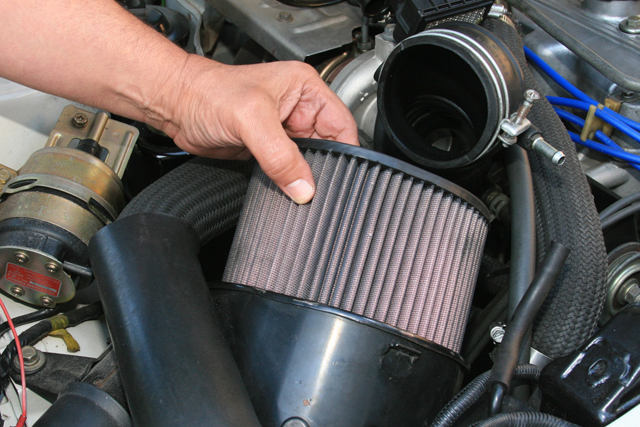
Separate airbox and remove the old air filter for inspection. While wrestling with the clips and tubes be careful not to tear the intake hose or damage sensors. This air filter is of the reusable type and is A-OK.

Separate airbox and remove the old air filter for inspection. While wrestling with the clips and tubes be careful not to tear the intake hose or damage sensors. This air filter is of the reusable type and is A-OK.

Vehicles with a carburetor like the Starlet have a donut-looking air filter that usually lives up on top of the carburetor itself. Loosening clips and hoses may be accompanied by removal of a surprisingly easy to misplace wingnut. Time for a new air filter here.

Vehicles with a carburetor like the Starlet have a donut-looking air filter that usually lives up on top of the carburetor itself. Loosening clips and hoses may be accompanied by removal of a surprisingly easy to misplace wingnut. Time for a new air filter here.

A shop vacuum works well to remove any leftover debris settled in the airbox, such as that carelessly discarded Abbaa Zabba wrapper that got sucked into the aircan and threw the Check Engine Light.

A shop vacuum works well to remove any leftover debris settled in the airbox, such as that carelessly discarded Abbaa Zabba wrapper that got sucked into the aircan and threw the Check Engine Light.

Install the new filter if needed, making sure it seats in the airbox or air can housing. Reinstall any clips or fasteners. Reconnect and retighten anything loosened during disassembly. Check to see if airbox parts form a tight seal before starting engine.

Install the new filter if needed, making sure it seats in the airbox or air can housing. Reinstall any clips or fasteners. Reconnect and retighten anything loosened during disassembly. Check to see if airbox parts form a tight seal before starting engine.

2 Responses

  1. jeremy! Said,

    Back when i had my Lebaron i took the airbox off. For one day that little 2.2 sounded so good.

    Posted on April 13th, 2009 at 2:34 pm

  2. dom Said,

    Nice article. I think it’d be wise to advise readers that certain air filters are directional (sometimes indicated by arrows), and care should be taken to ensure that the filter is installed in the proper direction (especially for reusable filters). Keep it up!

    Posted on April 19th, 2009 at 7:39 pm

Tool of the Week: Fiat SST

Posted by Mike Bumbeck
Sep-3-2010 I 1 COMMENT

Replace Window Regulator

Posted by Mike Bumbeck
Aug-28-2010 I 1 COMMENT

Five Tips for DIY Automobile Repair

Posted by Mike Bumbeck
Jul-21-2010 I 8 COMMENTS